

Rowsfire A109 ECAM Panel Review (2025): Is It Worth It for Your A320 Home Cockpit?
⚡ Quick Verdict
| Best For | Serious A320 home cockpit builders who want study-level ECAM control |
| Simulator Support | MSFS 2020 / 2024, X-Plane (via MobiFlight) |
| Compatible Aircraft | Fenix A320, FlyByWire A32NX, ToLiss (X-Plane) |
| Connection | USB-C · no external power · no drivers needed |
| Mount Options | Desk-stable (standalone) + rear mount point for rig integration |
| Setup Time | ~2–10 minutes via QR code + Rowsfire App or MobiFlight config file |

Introduction: What Does the A109 Actually Do?
If you've ever sat in the left seat of a real Airbus A320, you know the ECAM (Electronic Centralized Aircraft Monitor) panel isn't something you interact with constantly — but when you need it, you need it fast. Engine bleed issues on climb, hydraulic warnings, fuel imbalance — every one of these scenarios sends your hand to the ECAM switching panel before anything else.
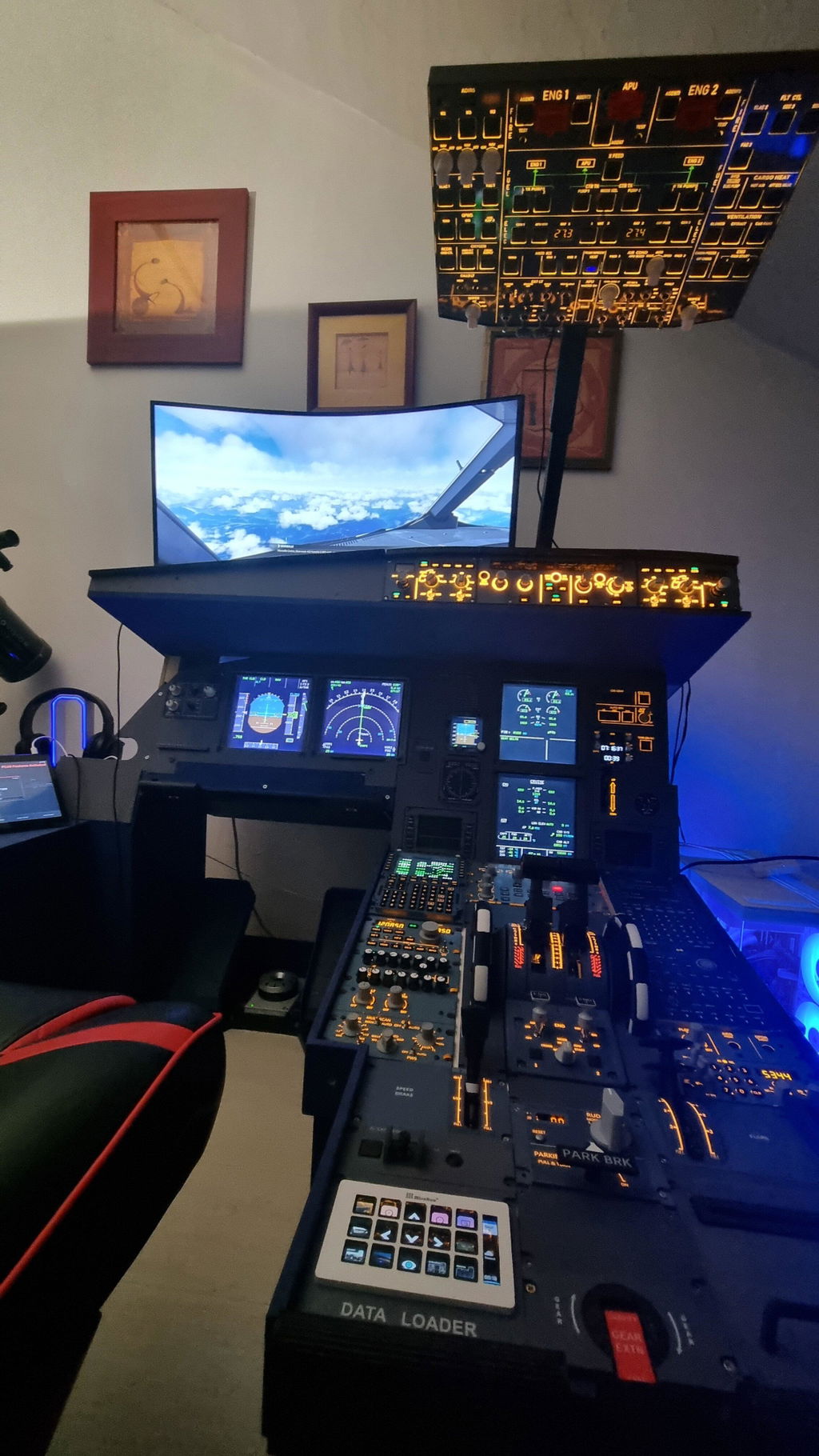
The Rowsfire A109 is a physical replica of that switching panel, combined with ADIRS (Air Data Inertial Reference System) controls. It's designed for simmers building serious Airbus cockpits who are tired of hunting for on-screen buttons at critical moments. After hands-on testing during a full cold-and-dark startup at Sacramento KSMF using the Fenix A320 on MSFS 2024, here's everything you need to know.

What Is the ADIRS Panel in a Real Airbus?
The ADIRS — Air Data Inertial Reference System — is the backbone of flight data on the Airbus A320. It consolidates inputs from pitot probes, static ports, and inertial sensors to produce the aircraft's speed, altitude, attitude, and navigation data. In plain terms: if the ADIRS fails, the aircraft loses its core flight instruments.
The physical panel in the cockpit allows pilots to align the IRS units, select data sources (ADR 1/2/3), and monitor system status. In simulation, controlling this with physical hardware rather than mouse-clicks adds a layer of procedural accuracy that study-level simmers actively seek out.

Rowsfire A109: Product Overview & Specs
| Panel Type | ECAM switching panel + ADIRS controls (A320 layout) |
| Build Material | Quality plastic housing — dense, no hollow feel, no flex |
| Buttons | Firm tactile switches — all labeled, accurate spacing |
| Backlighting | Uniform LED, adjustable brightness, bidirectional sim sync |
| Connection | USB-C (cable included), no external power supply required |
| Software | MobiFlight (free) — config file v3 provided via QR code + website |
| Manual | 31-page printed manual (English) |
| Mounting | Desk-stable without support; rear mount point included |
Unboxing & First Impressions
The packaging is clean and well-organized. Inside the box:
- Rowsfire A109 ECAM panel
- USB-C cable
- 31-page instruction manual (English)
- QR code card linking to the MobiFlight config file and setup tutorial

The first thing you notice when you pick up the A109 is that it doesn't feel cheap. The plastic housing has real density to it — no hollow rattling, no visible flex when handled. It's not a metal-frame build, but it's a significant step above budget peripherals that feel like they'd crack under regular use.
What stands out immediately: the backlighting. The LED illumination is genuinely uniform — no hotspots, no dark corners. Rowsfire achieves this through a transparent diffuser layer that distributes the light evenly across the entire panel face. The first look at it lit up is impressive, especially for the price point.
The button layout is authentic Airbus-style, accurately spaced so adjacent switches don't interfere. Labeling is crisp and printed directly onto the panel surface. One minor note: the buttons share the same mold design as the A107 overhead panel — which is fine functionally, but enthusiasts who prefer grainier textures over smooth plastic may notice it. Rowsfire has acknowledged this and is expected to refine button texture in future versions.
MobiFlight Setup: Fast and Painless
The A109 is not plug-and-play in the traditional sense. It requires MobiFlight, a free open-source software bridge. But 'not plug-and-play' is misleading here, because Rowsfire has made the setup as frictionless as possible.
Step-by-Step Setup
- Scan the QR code included in the box (or visit the Rowsfire website directly)
- Download MobiFlight Connector 10.5 and the A109 config file (Version 3 recommended)
- Open MobiFlight → load the config file → select the A109 from the device dropdown → click Assign → click OK
- Connect the A109 via USB-C — the panel runs a startup light sequence confirming it's recognized
- Launch MSFS 2024 and load the Fenix A320 — MobiFlight shows green status for both SIM and device

Total setup time in testing: under 10 minutes, including downloading the software. No external power brick, no proprietary drivers, no adapters. The USB-C connection handles everything.
Performance: Cold Start Demo on Fenix A320
Startup Sequence
Testing was conducted with the Fenix A320 in cold-and-dark state at Sacramento KSMF (Gate 1). The A109 was connected via MobiFlight with all statuses confirmed green before APU startup.
During the startup sequence, the panel responded exactly as expected: lights activated when APU came online, ECAM switching buttons reflected their real-world function in-simulator with no perceptible lag. Every button was cycled — Engine, Cabin Pressure, Electric, Hydraulics, Fuel, Wheel, APU, Doors, Status — and all produced immediate, accurate ECAM page changes on-screen.
Response Time
Response latency was tested deliberately: buttons held, rapidly cycled, and switched during active system changes. Zero lag was observed across all inputs. For immersion purposes, this is the single most important performance metric — a half-second delay between physical button press and sim response breaks the experience entirely. The A109 passes this test cleanly.
Backlighting Sync
The bidirectional brightness sync worked as advertised. Adjusting panel brightness from the sim's overhead controls reflected on the A109 hardware, and vice versa. Time-of-day changes in the sim (switching from daytime to night flying) also triggered appropriate lighting response on the panel.

Pros and Cons
✅ Strengths
- Dense, solid build — no flex or hollow feel
- Uniform LED backlighting via diffuser layer
- Bidirectional brightness sync with simulator
- Zero input lag on all ECAM switches tested
- Setup under 10 mins via QR code + MobiFlight v3
- No fingerprint retention — low-maintenance surface
- Accurate A320 layout with proper screw spacing
- No drivers, no external power — clean USB-C only
⚠️ Weaknesses
- Buttons share same mold as A107 — smooth texture, not grainy
- No dedicated stand included — desktop placement needs planning
- Button interior indicators could benefit from contrast stickers
- Not suitable for casual simmers — niche use case

Who Is the Rowsfire A109 For?
The A109 is a specialized piece of hardware. Unlike the A105 Radio Panel — which benefits almost any A320 simmer — the ECAM panel has a narrower but passionate audience:
- Home cockpit builders constructing a dedicated A320 simulation rig
- Study-level simmers who follow real Airbus SOPs and want physical ECAM access during startup and system checks
- VATSIM / IVAO pilots managing multi-system monitoring during high-workload phases
- Simmers expanding an existing Rowsfire ecosystem (A107 overhead + A105 radio + A109 ECAM)
It's less compelling if:
- You fly casually and rarely interact with ECAM pages beyond the default engine display
- You're not yet committed to an Airbus-specific setup
- You need a fully plug-and-play solution with no software configuration

Final Verdict
The Rowsfire A109 is a serious piece of hardware for serious Airbus simmers. It's not flashy, not gimmicky — it does exactly what it says, responds exactly when you need it, and integrates cleanly into a wider Rowsfire ecosystem or mixed hardware rig.
The build quality is convincing for the price point. The uniform backlighting is genuinely impressive. The MobiFlight setup is as painless as this category of hardware gets. And the zero-lag response across all ECAM inputs means it passes the fundamental immersion test.
Minor gripes — button texture preference, no included stand, potential for button contrast improvements — are real but cosmetic. None affect functionality.
Bottom line: if you're building an Airbus cockpit step by step, the A109 belongs on your list. It's the kind of panel you install once and use on every flight without thinking about it — which is exactly what good cockpit hardware should be.
FAQ — People Also Ask
Does the Rowsfire A109 work with MSFS 2024?
Do I need MobiFlight to use the A109?
What is the difference between the A109 and the A107?
Does the A109 work with X-Plane?
Is the A109 worth it if I'm not building a full cockpit?
How does the backlighting compare to other Rowsfire panels?
🛒 Ready to add the A109 to your cockpit?
Check current pricing and stock on the official product page.
Shop the Rowsfire A109